In today’s complex healthcare environment, shared governance and professional governance have become essential strategies for organizations seeking to improve workforce engagement, leadership development, quality outcomes, and sustainable nursing excellence.
Excellence is no longer achieved through isolated initiatives or top-down mandates alone. It emerges when empowered professionals, strong leadership behaviors, and healthy organizational cultures align around a shared purpose.
At the center of this alignment is shared governance/ professional governance, a structure and philosophy that elevates point-of-care voice, strengthens accountability, and connects daily practice to organizational priorities.
When implemented effectively, shared governance becomes more than a committee structure. It becomes the operational framework that drives engagement, collaboration, innovation, quality improvement, and professional ownership throughout the organization.
This article explores how governance, culture, leadership behaviors, and outcomes connect, and why organizations that intentionally weave them together create the conditions for sustainable excellence.

What Is Shared Governance in Healthcare?
Shared governance is a leadership and decision-making model that empowers point-of-care clinicians to influence professional practice, quality outcomes, operational improvement, and workplace culture through collaborative structures and shared accountability.
Professional governance expands on this concept by aligning professional practice, leadership behaviors, accountability, and organizational strategy to support sustainable excellence across the healthcare environment.
When organizations implement shared governance/ professional governance effectively, clinicians are not simply participating in discussions, they are actively shaping practice environments and driving meaningful improvements in care delivery.
To learn more on shared governance and professional governance, visit our recent blog here.
Shared Governance and Professional Governance as the Engine of Professional Practice
High‑performing shared governance systems are built on four core principles:
- Autonomy
- Accountability
- Partnership
- Ownership
Shared governance councils become micro‑systems of leadership development where clinicians learn to analyze data, solve problems, and influence practice.
The most effective councils operate not as advisory groups but as true decision‑making bodies. They identify gaps, propose solutions, and partner with leaders to implement and evaluate change.
These councils:
- Strengthen professional identity; focus on structures and processes to build professional
- Build leadership capacity -through council work leaders are grown and succession planning can be seen in the council structure
- Create transparency in decision‑making; decisions are shared with colleagues and leaders in the organization
- Foster shared responsibility for outcomes; ownership of outcomes belong to everyone and are not reserved for leadership
Organizations that invest in this level of empowerment see stronger engagement, higher retention, and more consistent practice standards across settings.
How Shared Governance Supports Quality and Safety Outcomes
Quality and safety outcomes improve when point-of-care clinicians have the authority and support to act on what they see every day.
Shared governance/ Professional governance councils play a critical role in:
- Monitoring nursing‑sensitive indicators
- Elevating trends in patient experience
- Identifying patterns in safety events
- Addressing barriers to operational efficiency
Rapid cycle improvement becomes a core competency. Councils learn to test small changes, evaluate impact, and scale what works. When teams see their decisions move a metric, whether reducing falls, improving communication, or enhancing care transitions, it reinforces the value of shared ownership.
Point-of-care clinicians often need education and guidance on monitoring, analysis and responding to quality data. Make education on data a part of shared governance/ professional governance orientation and ongoing education. Clinicians at the point-of-care/point-of-service have great solutions for improving outcomes, they often need the skills and resources to evaluation and respond to data.

Culture of Nursing Excellence: How Culture and Leadership Influence Shared Governance Success
Even the strongest shared governance structures cannot thrive without the right culture.
A culture of nursing excellence is defined by:
- Trust
- Transparency
- Psychological safety
- Shared values
- Consistent leadership behaviors
Leaders set the tone. Their micro‑behaviors, how they listen, respond, coach, and recognize, either reinforce or erode the culture. When leaders model curiosity, humility, and accountability, teams feel safe to speak up, innovate, and challenge the status quo.
We celebrate voice in shared decision making, but we rarely talk about the discipline, humility, and skill of listening. Yet shared decision‑making only works when both are present. Voice without listening becomes noise. Listening without voice becomes silence. Shared governance/ Professional governance requires both to create meaning, alignment, and action.
Culture amplifies governance. It accelerates improvement. It creates conditions where quality outcomes are not episodic, they are sustained.
Connecting Governance, Engagement, and Sustainable Excellence
When governance, outcomes, and culture are aligned, a powerful cycle emerges:
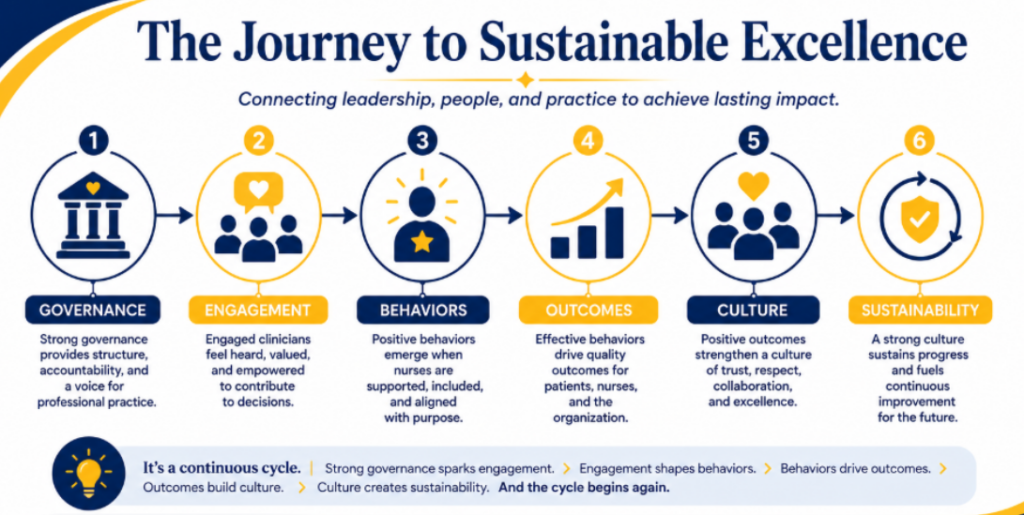
When these elements align, they create more than a framework, they form the organization’s operating rhythm, the cadence by which teams think, act, and improve together.
Governance provides the structure, clarity, and decision‑making pathways that empower point-of-care voice.
Engagement follows naturally when every member understands their role and shares ownership of outcomes.
Behaviors shift as teams practice accountability, transparency, and collaborative problem-solving.
Outcomes improve because decisions are grounded in data, lived experience, and shared purpose.
Culture evolves as these outcomes reinforce trust, pride, and a collective belief in what is possible.
Sustainability emerges when this cycle becomes enculturated, not dependent on individuals, but embedded in how the organization functions.
When councils align their charters, priorities, and agendas with strategic goals, the work becomes meaningful. Engagement rises because people see the impact of their contributions. Data becomes transparent and actionable. Leaders and teams share a common mental model for improvement. The “golden thread” between governance and outcomes becomes visible in everyday practice.
And sustainability? It’s no longer something we chase, it’s something we live, because excellence has become part of the culture itself.
Practical Strategies to Strengthen Shared Governance
Organizations seeking to strengthen shared governance and professional governance can focus on several foundational strategies: Articulated expectations for council roles and responsibilities
- Clear decision-making authority and defined scope
- Accountability structures that support follow-through
- Coaching behaviors that empower rather than direct
- Embedding improvement thinking into daily practice
These strategies help councils mature, increase impact, and sustain momentum over time.

Building a Sustainable Culture of Excellence
Sustainable excellence does not emerge from isolated initiatives. It develops when organizations intentionally connect governance, leadership, engagement, culture, and outcomes into a unified professional practice environment.
Every leader, every council, and every clinician plays a role in strengthening that connection.
The question is no longer whether shared governance matters.
The question becomes:
How intentionally are we using it to shape the future of care delivery, workforce engagement, and organizational excellence?
Sustainable excellence begins with intentional choices. And it grows when those choices are shared.
Creative Health Care Management (CHCM) partners with healthcare organizations to strengthen shared governance, leadership development, workforce engagement, and nursing excellence through consultation, education, and professional practice transformation strategies designed to support sustainable outcomes.
Connect with CHCM to learn how we can support your organization’s journey toward sustainable excellence.

Frequently Asked Questions About Shared Governance
What is shared governance in nursing?
What is professional governance in health care?
Why is shared governance important?
How does shared governance improve patient outcomes?
What role do leaders play in shared governance?
Marky has expertise in aligning people and processes, identifying emerging issues, and assessing the effectiveness of organizational interventions. The result: enduring measurable improvement. Marky uses her deep health care experience along with evidence-based practices to co-create a customized improvement plan with clients.