Annual competencies in healthcare are intended to support safe practice, professional development, and improved outcomes. However, when mistakes and errors occur in organizations, it is your obligation to analyze these problems and assess the reason or reasons they occurred.
Why Annual Competencies in Healthcare Require Careful Analysis
These problems have many different names: sentinel events, incidents, and near misses. When these errors occur, we often form a task force or committee to examine the situation, discuss it, diagram the reasons it occurred, and so on. The action of reflecting on the events is both valuable and important. Where we often get stuck in our efforts to make things better is that, when mistakes or errors occur, healthcare organizations sometimes respond by assigning mandatory education or competency requirements to everyone, even when the problem is isolated to one individual, team, or department. Even if 80% of the departments are struggling with something, it does not always merit education to all. Education is valuable, but it is not always the answer.
Before adding another organization-wide annual competency, healthcare leaders and educators must determine why the problem occurred and whether a true gap in knowledge, skill, or ability exists. Otherwise, they risk ‘spraying’ education across the organization without addressing the actual cause of the problem.

The Risks of Assigning Education Across an Organization
Most people say, “Well, education can’t hurt.” But I beg to differ. It can actually do a great deal of harm. If we use educational strategies to address anything other than an education deficit, we send the inappropriate, and even damaging, message to our employees that they are not smart enough to carry out the work.
That message, when sent too often or at the wrong times, can create an attitude of “Who cares?” or “Why try?” If an area of the organization works hard to improve, but another area makes a mistake, applying education across the board can actually hurt your overall outcomes.
How Unnecessary Mandatory Competencies Affect High Performers
It also often happens that our broadly applied efforts to improve the skills in which a few people are falling short can make the people who are excelling feel unseen and unappreciated. With this broadly applied approach, the “excellers” have to do the mandatory activity despite already demonstrating excellent outcomes. They start to question why they’re asked to track their outcomes at all. They wonder why they try to improve and be proactive when their efforts are never really acknowledged.
I have seen numerous organizations that use too many educational responses or mandatory competencies to solve problems turn good teams into mediocre teams, which inevitably turns good organizations into mediocre organizations. Teams and groups see little reason to be proactive when their efforts are not recognized.
Education Is Valuable When There Is an Educational Need
Of course, education is valuable. But you should use education only when there is a clear indication of an educational need. Make sure you do a comprehensive reflection that includes all areas of possible deficit:
- System problems
- Availability of tools / resources
- Departmental barriers
- Communication barriers
- Attitudinal issues
- Individual performance patterns
- Any other barriers that hinder people from taking the right actions

Two Ways to Improve Annual Competency Assessment in Healthcare
Here are two things that will help every educator and leader in healthcare avoid falling into the trap of using the broad application of education
1. Conduct a Systematic Reflection Before Using Education
First and foremost, please do a full comprehensive reflection on the situation before using any education response or intervention in an effort to improve outcomes. This analysis is well worth the time and resources.
Ask yourself, is there truly a gap in knowledge, skill, or ability?
Typically, there are many other contributing factors: systems issues, communication breakdowns, siloed department responses or support, disruptive attitudes or behaviors, issues with availability of appropriate tools or supplies, distractions in the work environment, etc.
2. Select Annual Competencies Based on Outcomes
When a problem is identified and thoroughly explored, do not automatically respond to that problem with an organization-wide mandatory competency.
Instead use the Donna Wright Competency Assessment Model™ to identify the competencies that are needed for each area. With this approach, we are not forcing a group or team to do any one competency. We are requiring them to consider this as a competency in light of their outcomes.
Using the Donna Wright Competency Assessment Model™ to Identify Meaningful Competencies
Under this approach, each group or team considers the potential competencies based on their own performance and outcomes, even when the original mistake occurred in another area. Your team will be given the outcomes and objectives that are desired for the job performance and are asked to reflect on their outcomes in the area. If you are achieving the desired outcome, you do not need to consider a competency. However, if you show problems in this area or don’t have enough data to be certain of what your outcomes may be, you need to consider this as one of your competencies for this time period.
Recognize High Performance and Address Demonstrated Gaps
This approach will help you move away from the broad educational approach and get you to a place where high performance is recognized and lower performance is addressed; but only in the areas that need it. This will save time and money while contributing to an environment that focuses on and rewards excellence. Following this guidance, you also put ownership into the hands of the people who do the work every day, guided by the leadership vision for the whole organization.
Build a More Meaningful Approach to Competency Assessment
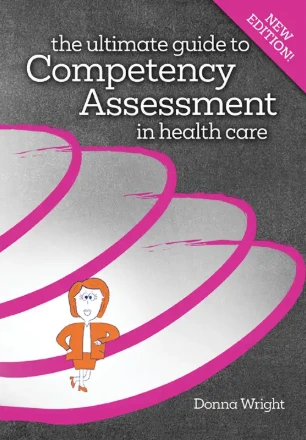
Ready to rethink annual competencies in your organization? Explore the Donna Wright Competency Assessment Model™, learn more about Donna Wright, or discover practical strategies in her book, The Ultimate Guide to Competency Assessment in Health Care.
Frequently Asked Questions About Annual Competencies in Healthcare
Annual competencies in healthcare are selected areas of professional practice that an organization assesses to determine whether employees can apply the necessary knowledge, skills, abilities, and judgment in their roles. Effective competency assessment evaluates demonstrated performance rather than participation in education alone.
No. Education helps employees gain or strengthen their knowledge and skills. Competency assessment validates whether an employee can apply that knowledge and skill in practice. Completing an educational module does not automatically demonstrate competency.
Organizations should use quality data, outcome trends, incident reports, patient and staff feedback, changes in practice, new equipment, high-risk processes, and identified performance gaps to select meaningful competencies.
Not necessarily. Some requirements may apply across an organization, but many competencies should be selected according to job responsibilities, department outcomes, patient populations, identified risks, and demonstrated performance needs.
Education provides information and learning opportunities. Competency assessment determines whether professionals can use their knowledge, skills, abilities, and judgment effectively in practice. As the Association of Nurses in Professional Development (ANPD) explains, education helps build competency, but education alone does not guarantee it.
Source: ANPD