
Do your eyes glaze over when the topic of nursing research comes up? Do you fall asleep when you’re asked to read a research report? Do you shudder at the thought of the Magnet® requirement for nursing research? If so, you’re not alone. I worked with a colleague who, when I even mentioned the word “research,” she would hold up her hand in the stop position and say, “Speak to the hand.”
What Is Nursing Research?
Nursing research is the systematic investigation of questions that improve patient outcomes, nursing practice, workforce well-being, and healthcare delivery.
Through nursing research, nurses generate evidence that helps healthcare organizations make informed decisions, improve care processes, and create better experiences for patients, families, and staff.
Research is not reserved for nurse scientists or academic institutions. Staff nurses, nurse leaders, NPD practitioners, clinical educators, and advanced practice nurses all have opportunities to contribute to nursing research and evidence-based practice initiatives.
The best nursing research often begins with observations made at the bedside. For more on nursing research, you can explore one of our previous blogs here.

Why Nursing Research Matters
Nursing research is guided by a sense of wondering, and the impact of it can be seen throughout modern healthcare.
For example, In the 1980s, Dr. Nancy Bergstrom, a registered nurse (RN), wondered about predicting patients’ risk for pressure injuries. She collaborated with another nurse, Dr. Barbara Braden, to develop the Braden Scale (Bergstrom et al., 1987). The Braden Scale is widely used in practice today to prevent pressure injuries through evidence-based interventions.
In the early 2000s, Dr. Linda Aiken, also a registered nurse (RN), wondered if nurse staffing had an impact on patient outcomes (Aiken et al., 2002). Over the course of several studies, she looked at the relationship between nurse staffing and patient outcomes and discovered that higher RN staffing was related to decreased mortality and increased satisfaction among patients. In yet another example, Meade, Bursell, and Ketelsen (2006), all nurses, wondered how nurses could reduce patient call lights. Their study found that regular patient rounding at 1 to 2-hour intervals reduced falls, reduced patient use of call lights, and increased patient satisfaction.
Fast forward to now. Siegmund and colleagues (2025), of the Cleveland Clinic (2026), identified risk factors for frailty and created the Frailty Care Model to inform care for adults over 65 years old.
Each of these studies began with a question. Each resulted in meaningful improvements to patient care. And each demonstrates the lasting impact nurses can have through research.
How Nursing Research Improves Patient Outcomes
Research findings directly influence clinical practice.
Just today, my family member was advised to chew gum after a colon resection. Having been away from the bedside for several years, this was a new practice to me. So I immediately went to the literature to find the research that supported the practice.
While the origin of the practice did not emanate from nursing research, nurses have conducted studies with different patient types to determine if gum chewing can benefit patients with different types of surgery. When I looked at a systematic review, which is an analysis of the existing research on the topic, which happened to be performed by nurses, the evidence supports the intervention (Lew et al., 2025).
This example illustrates an important reality: nursing research helps nurses evaluate practices, validate interventions, and continuously improve patient care.
Without research, many of the practices we consider routine today would never have become standard care.

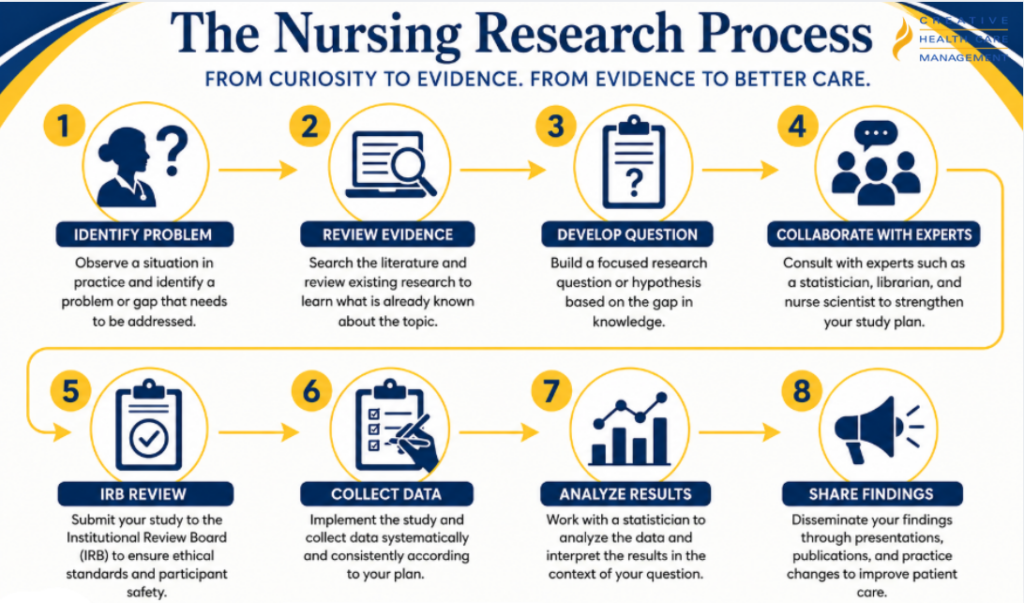
The Nursing Research Process: Step by Step
One common misconception is that nursing research is overwhelming or inaccessible. In reality, research follows a structured process that can be learned and supported.
Consider the example that I witnessed recently of a group of nurses who wanted to address staff burnout within their organization.
*The details are based on personal recall and do not necessarily accurately reflect the processes reported by the investigators.
Step 1: Identify a Problem or Gap
Every research study begins with a question, and, in my experience, the toughest part of research is identifying a problem. Consider:
- What have you noticed recently and wondered about?
In this example, nurses observed increasing levels of stress and burnout among staff members and wanted to explore potential solutions.
Step 2: Review Existing Evidence
The next step is determining what is already known.
Working with their organization’s librarian, the curious nurses found journal articles related to their area of interest. They identified many types of interventions for stress, but they didn’t find any studies that examined using brief stress relief exercises during the nurses’ shift. This gap in the literature provided an opportunity for further investigation.
Side note: If your organization has access to a librarian, this person is an invaluable resource; become besties with your librarian! Occasional homemade cookies or brownies make excellent gifts.
Step 3: Develop a Research Question
After finding no literature that related to their area of interest, these staff nurse investigators developed a research question:
- Will a 5-minute wellness intervention practiced daily for 1-month during their shift lessen staff nurses’ stress as measured by the 10-question Perceived Stress Scale (PSS-10)?
A clear research question provides direction for the entire study.
Once this question was formulated, the nurse investigators met with the organization’s statistician to review the study plan and to ensure data were collected in a manner that facilitates analysis.
Never, ever, ever forget this step. A statistician is an integral member of your research team and can ensure that the data you collect is usable and will address your research question. Another bestie to cultivate… bring cookies.
Step 4: Obtain Ethical Review
The nurses’ organization has an institutional review board (IRB), that reviews research to ensure it presents minimal risk to the participants. This step is required for any research that involves people.
The investigators of this case created a consent form for participants to sign before participation. This form explained the purpose of the research, what the participants would be asked to do, and that participation in the study presented no risk to the participants.
Once the consent form was developed, the investigators completed and submitted the electronic IRB request form. The IRB determined the study was “exempt,” which means it presents minimal risk to the nurses who participate, and gave clearance for the investigators to continue.
Step 5: Collect Data
The nurse investigators attended unit-based council meetings to explain the research and invite nurses to participate. Volunteers were asked to sign the consent form. Once
the consent was obtained, the participants completed the Perceived Stress Scale (PSS-10).
Then, the investigators taught the participants three different stress-relief exercises. They instructed the participants to implement each exercise during their break for a total of five minutes each shift and record completion on a form provided by the investigators.
At the end of one month, the participants completed the PSS-10 again.
Step 6: Analyze the Data
The nurse investigators provided the pre- and post-survey data to the organization’s statistician, who conducted the analysis using a statistical computer program.
Step 7: Interpret the Results
Once the data analysis was complete, the nurse investigators met with the statistician to review the statistics. The statistician helped them understand what the statistics meant. They collaboratively discussed the significance of the findings (results) and implications for practice.
Step 8: Share the Findings
The findings showed that the staff nurses’ perceived stress was significantly less after a month of using brief stress-relief practices during their shifts. In nursing research, the word “significant” means that the difference was more than what would be expected to occur by chance.
The nurse investigators reported the findings to senior leadership and recommended that the intervention be expanded to other units.
Additionally, they presented at their organization’s annual research day and submitted an abstract to their specialty organization for consideration for a poster or podium presentation at the annual conference. Disseminating findings is an essential part of the nursing research process because it allows others to learn from and build upon the work.
Reflecting on the Nursing Research Process
As I heard these nurses, none of whom had PhDs, none of whom had previously conducted nursing research, I was moved by their excitement and pride in their accomplishment. They had dared to wonder, they had just given their first presentation of their findings, and, most importantly, they had made a difference for the staff who participated!
So I ask you to think, what have you wondered?
Common Barriers to Nursing Research
While many nurses are interested in research, several challenges can make participation difficult.
Common barriers include:
- Limited time
- Lack of research experience
- Limited access to mentorship
- Uncertainty about statistics
- Limited organizational resources
- Absence of a nurse scientist
These barriers are real, but they are not insurmountable.
With appropriate support, nurses at every level can successfully participate in research initiatives and contribute to evidence-based practice.
Building a Culture of Nursing Research
Organizations that excel in nursing research create environments where curiosity is encouraged and inquiry is supported.
Strong nursing research programs often include:
- Research councils
- Dedicated mentorship opportunities
- Partnerships with nurse scientists
- Access to librarians and statisticians
- Leadership support
- Opportunities for dissemination and publication
When organizations invest in research, they strengthen professional practice, improve patient outcomes, and enhance nurse engagement.
Perhaps most importantly, they empower nurses to transform questions into meaningful improvements.

Nursing Research Support
Many nurses have the benefit of a nurse scientist who is employed by their organization and who guides them through the steps of research. Nurse scientists are PhD-prepared to conduct research. In healthcare settings, they lead research initiatives and facilitate research conducted by staff, both nursing and other professions. They often help obtain funding for research projects.
Unfortunately, not all healthcare organizations have a nurse scientist. Creative Health Care Management (CHCM) can help fill that void.
CHCM has launched the Nursing Research Partnership (NRP) to strengthen a culture of inquiry by providing structured, PhD-prepared nurse scientist mentorship to advance nurse-led research and dissemination in organizations that do not have a nurse scientist.
Through this partnership, organizations can:
- Strengthen a culture of inquiry
- Develop nurse-led research studies
- Navigate IRB processes
- Improve research readiness
- Support data analysis and interpretation
- Increase dissemination and publication opportunities
- Advance evidence-based nursing practice
Whether your organization is launching its first nursing research initiative or seeking to expand an existing program, expert mentorship can help transform curiosity into meaningful outcomes.
Explore our Nursing Research Partnership or connect with our nurse scientist to learn how CHCM can support your nursing research program.

Frequently Asked Questions About Nursing Research
Nursing research is the systematic study of questions that improve patient care, nursing practice, health outcomes, and workforce effectiveness.
Nursing research provides evidence that guides clinical decision-making, improves patient outcomes, enhances nurse satisfaction, and advances the nursing profession.
Absolutely. Many successful nursing research projects are led by staff nurses who identify opportunities for improvement within their practice environments.
A nurse scientist is a PhD-prepared nurse researcher who leads studies, mentors nurses, secures funding, and supports research initiatives within healthcare organizations.
Organizations can support nursing research by providing mentorship, creating research councils, partnering with nurse scientists, encouraging dissemination, and fostering a culture of inquiry.
Sources
Aiken, L.H., Clarke, S.P., Sloan, D.M., Sochalski, J., & Silber, H. (2002). Hospital nurse staffing and patient mortality, nurse burnout, and job dissatisfaction. Journal of the American Medical Association, 288(16), pp. 1987-1993. 1001/jama.288.16.1987.
Bergstron, N., Braden, B.J., Laguzza, V., & Holman, V. (1987). The Braden Scale for predicting pressure sore risk. Nursing Research, 36(4), 205-210.
Cleveland Clinic. (2026, June 1). Testing a nurse-led framework to identify and address frailty in older adults. https://consultqd.clevelandclinic.org/testing-a-nurse-led-framework-to-identify-and-address-frailty-in-older-adults
Lew, S.L., Cheng, L.J., Yap, S. Y, Liaw, Y.Q., Park, J. Sau, S. (2025). Effect of chewing gum on clinical outcomes and postoperative recovery in adult patients after gastrointestinal surgery: An umbrella review. International Journal of Surgery, 111(5), pp. 3481-3493. DOI: 10.1097/JS9.0000000000002332
Meade, C.M., Bursell, A., & Ketelsen, A.L. (2006). Effects of nursing rounds on patients’ call light use, satisfaction, and safety. American Journal of Nursing, 106(9), pp. 58 – 70.
Sigmund, L.A., Novosel, L.M., Bena, J.F., Morrison, S.L. (2005). Geriatric Nursing, 61,(Jan/Feb), pp. 672-680. https://doi.org/10.1016/j.gerinurse.2024.10.041
We look forward to the opportunity to bring the CHCM solutions to your organization.