Walk into almost any healthcare meeting today and data will be part of the conversation. Every day, healthcare leaders receive dashboards, quality indicators, patient experience scores, workforce metrics, safety reports, engagement results, benchmarking comparisons, and operational measures. We measure almost everything, and the volume of information available continues to grow. Some would argue healthcare is drowning in data while starving for improvement. So why do we collect it?
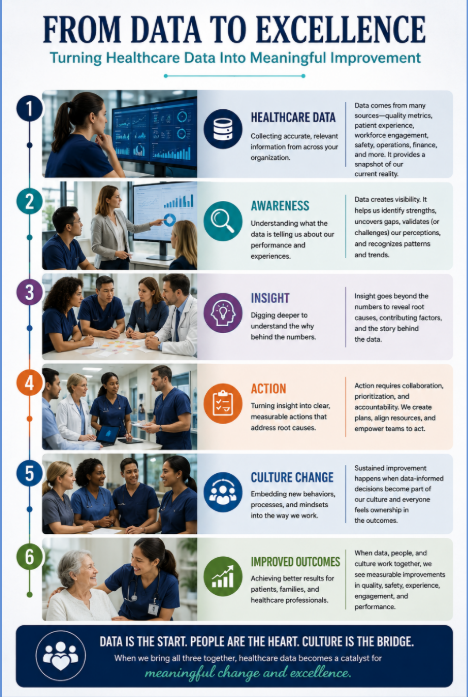
The answer is simple: healthcare data helps us understand our current reality, uncover opportunities for improvement, and guide meaningful actions that lead to better outcomes for the people we serve. However, having more data does not automatically create better outcomes. The true value of data is not found in the number of reports we generate or the dashboards we review. Its value lies in our ability to transform information into insight, insight into action, and action into meaningful improvement.
As healthcare continues to evolve, organizations that learn how to effectively use healthcare data will be better positioned to improve patient outcomes, strengthen workforce engagement, enhance quality, and achieve sustainable excellence.
What Is Healthcare Data?
Healthcare data includes the information organizations collect to evaluate performance, quality, safety, workforce experiences, patient outcomes, and operational effectiveness.
Examples of healthcare data include:
- Patient experience scores
- Employee engagement survey results
- Quality and safety metrics
- Patient fall rates
- Infection prevention measures
- Readmission rates
- Workforce retention and turnover data
- Financial performance indicators
- Benchmarking and comparison data
Organizations collect data to better understand what is happening within their systems and identify opportunities for improvement. Yet data alone does not create change. The organizations that achieve meaningful results understand that data is not simply about measurement. It is about understanding the story behind the numbers.

Healthcare Data Tells a Story
One of the most important things healthcare leaders can remember is that behind every data point is a person: a patient, a family member, or a healthcare professional. A fall rate is not just a number on a dashboard. It represents a patient whose independence, confidence, and recovery may have been affected.
A turnover percentage is not simply a workforce metric. It represents individuals making decisions about whether they feel valued, supported, and connected to their work. A patient experience score is not just a ranking. It represents moments of trust, communication, compassion, and partnership. Data is the autograph of the work being done in an organization. When leaders focus only on the numbers, they risk missing the deeper story data is trying to tell. The goal is not simply to monitor outcomes. The goal is to understand the human experiences, organizational conditions, and system influences that produced those outcomes.

Healthcare Data Creates Awareness
Data helps healthcare leaders answer important questions:
• Where are we excelling?
• Where are we struggling?
• Are our perceptions aligned with reality?
• Are there patterns we need to understand?
• Are we solving the right problems?
Without data, organizations often rely on assumptions, individual experiences, or the loudest voices in the room. Data provides a more objective view of reality. Improvement begins with awareness, and data creates the awareness necessary to move organizations forward. It allows leaders to identify strengths worth celebrating while also uncovering opportunities that require attention.
The Greatest Power of Data Is the Questions It Inspires
Many leaders view healthcare data as a source of answers. In reality, the greatest value of data may be the questions it inspires.
Questions such as:
• Why is one team thriving while another is struggling?
• Where are we struggling?
• What conditions allow excellence to occur consistently?
• What are our teams experiencing that the numbers alone cannot explain?
The goal is not simply to review the data. The goal is to understand what the data is inviting us to explore and improve. When leaders approach data with curiosity rather than judgment, they create opportunities for deeper learning, stronger engagement, and more effective improvement efforts.

Why Healthcare Data Without Action Creates Frustration
Healthcare teams are surveyed frequently and provide feedback about their experiences, challenges, and ideas for improvement. Yet many do nothing with the results. When healthcare professionals invest time sharing their experiences and nothing changes, trust begins to erode. When patients provide feedback and see no evidence of improvement, confidence can decline. Collecting data creates an expectation that action will follow.
This is why one of the first questions we ask organizations considering a survey or assessment is: “What is your plan for responding to the results?” The purpose of gathering healthcare data is not simply to generate a report. It is to create meaningful conversations, identify opportunities, and develop actions that lead to improvement.
Leaders must move beyond asking “What does the data say?” and begin asking “What are we going to do differently because of what we learned?”

How Culture Influences Healthcare Data
Sustainable improvement in data does not happen because a dashboard changes. It happens because behaviors, systems, processes, and cultures change.
A healthy data culture is one where teams:
• Understand their outcomes
• Participate in problem solving
• Have ownership in improvement
• See the connection between their actions and results
• Believe their voices influence change
The best organizations do not simply collect data. They build cultures where data creates curiosity, learning, and shared accountability.

Moving from Measurement to Meaning
The future of healthcare will not be defined by who has the most data, who uses AI to interpret results, or who has the large data sets to benchmark results. Instead, it will be defined by who can best translate data into meaningful action.
Data helps us see. People help us understand. Culture helps us change.
When organizations bring all three together, data becomes more than information; it becomes a catalyst for nursing excellence.
This is the first in a series of posts on healthcare data so be sure to check back frequently for the following blogs focus areas:
- Why access to data doesn’t guarantee improvement
- Finding the story behind healthcare data
- Creating action plans from data insights
- The human role in improving healthcare metrics
- How culture drives healthcare data metrics and excellence
Turn Healthcare Data Into Meaningful Improvement
Collecting healthcare data is only the beginning. The real challenge is transforming insights into actions that improve patient outcomes, workforce engagement, professional practice, and organizational culture.
Creative Health Care Management (CHCM) helps healthcare organizations move beyond measurement through proven solutions focused on Cultural Transformation, Professional Governance, the Interprofessional Relational Model™, Nursing Excellence, Leadership Development, workforce engagement, and strategic improvement initiatives. Our consultants partner with organizations to uncover the story behind the data, engage teams in meaningful improvement, and create sustainable results.
Ready to turn your healthcare data into action? Connect with Creative Health Care Management to learn how our experts can help your organization use data to drive meaningful and lasting improvement.
Frequently Asked Questions About Healthcare Data
What is healthcare data?
Why is healthcare data important?
How do healthcare organizations use healthcare data?
What are examples of healthcare data?
How does organizational culture affect healthcare data?
Why doesn’t collecting more healthcare data automatically improve outcomes?
What is a healthy healthcare data culture?
How can healthcare leaders use data more effectively?

Gen is driven by the desire to help clients create organizational excellence through measurable improvement. She thrives on helping others reach meaningful goals, including Magnet® designation.