Ask ten healthcare leaders how they define organizational effectiveness and you may receive ten different answers. Some leaders immediately point to financial performance. Others focus on patient outcomes, workforce retention, quality metrics, physician engagement, or patient experience scores. All are important measures, yet none fully captures the complexity of what it means for a healthcare organization to be effective.
Understanding what healthcare organizational effectiveness means is an important first step. The next is determining how leaders should evaluate it.
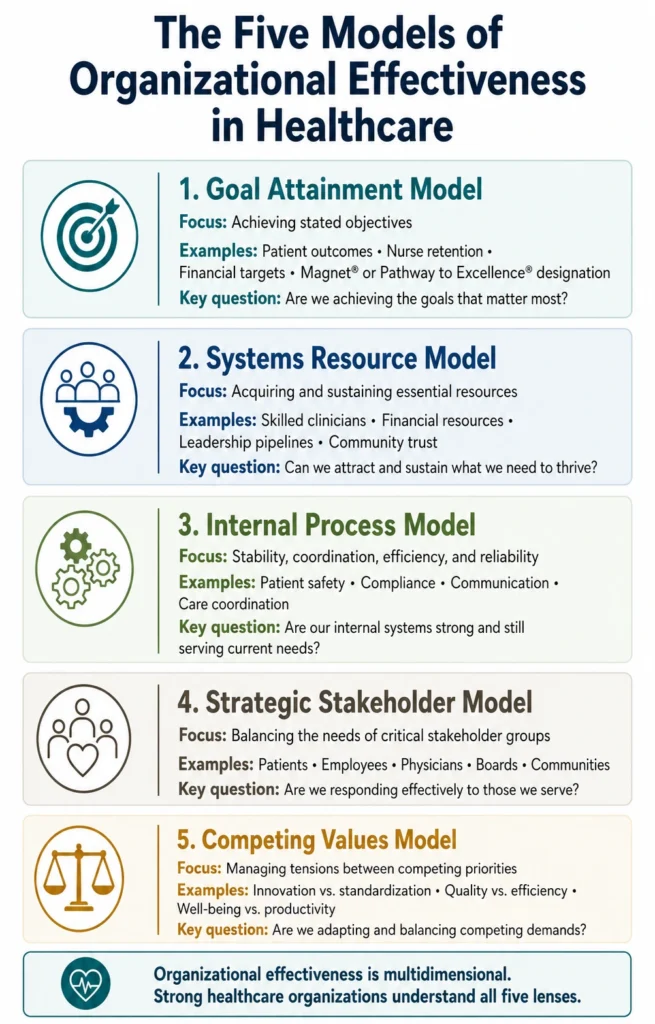
Organizational scholars have long recognized that effectiveness is not a single construct. Instead, it is a multidimensional concept viewed through different lenses, each offering unique insights into how organizations perform and what success looks like. For healthcare leaders, understanding these perspectives matters. The measures healthcare organizations prioritize ultimately shape decisions, investments, and strategy. If healthcare leaders define effectiveness too narrowly, they risk improving one area while unintentionally weakening another. Five widely recognized models of organizational effectiveness provide useful frameworks for understanding organizational performance in healthcare.
1. The Goal Attainment Model
The Goal Attainment Model examines healthcare organizational effectiveness through an organization’s ability to achieve its stated objectives. This is often the most familiar lens in healthcare. Organizations establish goals and then evaluate whether they achieved them.
Examples include:
· Reducing hospital-acquired infections
· Improving patient experience scores
· Increasing nurse retention
· Achieving financial targets
· Reducing length of stay
· Obtaining or maintaining Magnet® or Pathway to Excellence® designation
This perspective offers clarity and accountability because goals are measurable and progress can be monitored over time. Yet, healthcare organizations rarely pursue a single goal. They often manage dozens of objectives simultaneously, some of which compete with one another. Efforts to improve productivity may increase workload pressures, while aggressive cost reduction initiatives may affect workforce engagement or innovation. The Goal Attainment Model encourages leaders to ask an important question: Are we achieving our goals, and are we measuring the goals that matter most?
2. The Systems Resource Model
The Systems Resource Model views healthcare organizations as open systems that depend on their environments for resources, talent, information, and support. From this perspective, effective organizations are those that can successfully acquire and sustain the resources needed to survive and thrive. In healthcare, indicators of effectiveness may include:
· Recruiting and retaining skilled clinicians
· Building strong physician partnerships
· Securing financial resources and reimbursement
· Developing leadership pipelines
· Maintaining community trust
· Growing market share and reputation
This perspective matters in today’s healthcare environment where workforce shortages and financial pressures challenge organizations across the country. An organization’s ability to attract nurses, physicians, and leaders may be one of the strongest indicators of its long-term effectiveness.
3. The Internal Process Model
The Internal Process Model evaluates healthcare organizational effectiveness through stability, coordination, efficiency, communication, and operational reliability. Healthcare organizations viewed through this lens focus on the strength of their internal systems and processes. Internal Process measures often include:
· Patient safety outcomes
· Regulatory compliance
· Standardization of care delivery
· Communication effectiveness
· Care coordination
· Workflow efficiency
· Reduction in unnecessary variation
Healthcare organizations that perform well in this area typically demonstrate strong infrastructure, clear accountability, effective communication systems, and disciplined operational management. The risk, however, is becoming highly efficient at processes that no longer serve the needs of patients, clinicians, or communities. While efficiency is important, it alone does not guarantee effectiveness.
4. The Strategic Stakeholder Model
The Strategic Stakeholder Model, sometimes called the Strategic Constituencies Model, evaluates organizational effectiveness according to how well an organization meets the needs of its most important stakeholder groups.
Healthcare organizations exist to serve multiple stakeholders, each with their own expectations and priorities. Patients seek safe, compassionate, and timely care. Healthcare professionals want supportive work environments and opportunities for professional growth. Physicians value efficient systems and clinical excellence. Boards focus on stewardship and sustainability. Communities expect access, equity, and public accountability.
Through this lens, an effective healthcare organization is one that understands, balances, and responds to the needs of these critical groups. Measures for this lens may include:
· Patient experience outcomes
· Employee engagement scores
· Physician satisfaction
· Community trust
· Board confidence
· Partnership effectiveness
This lens reflects an important reality of healthcare leadership: organizations rarely thrive when one stakeholder group flourishes while others struggle.
5. The Competing Values Model
The Competing Values Model may be the most reflective of modern healthcare leadership because it recognizes that organizations constantly manage tensions between competing priorities. Healthcare leaders navigate these tensions every day. Examples of competing values include:
· Innovation versus standardization
· Flexibility versus stability
· Quality versus efficiency
· Workforce well-being versus productivity
· Local autonomy versus system consistency
· Financial stewardship versus mission fulfillment
The Competing Values framework suggests that organizational effectiveness is not achieved by maximizing one value while ignoring another. Instead, healthcare effectiveness comes from balancing competing demands and adapting as circumstances change. Highly effective healthcare organizations often demonstrate an ability to:
· Innovate while maintaining safety
· Improve quality while controlling costs
· Support workforce well-being while meeting operational demands
· Standardize care while preserving professional judgment
Leadership in healthcare is often less about choosing between competing priorities and more about managing them effectively.
How Healthcare Leaders Can Apply the Five Models
The five models are not simply academic theories. They provide healthcare leaders with practical questions for evaluating organizational effectiveness more comprehensively.
Goal Attainment
Are we achieving the clinical, operational, workforce, financial, and strategic outcomes we have identified as most important? Are those goals aligned with our mission and the current needs of our organization?
Systems Resources
Do we have the workforce, leadership, information, partnerships, financial resources, and community support needed to remain effective? Where could emerging resource gaps threaten our future performance?
Internal Processes
Are our systems reliable, coordinated, and efficient? Do communication structures, workflows, and accountability mechanisms support healthcare professionals in delivering safe, high-quality care?
Strategic Stakeholders
Do we understand what patients, healthcare professionals, physicians, boards, partners, and communities need from our organization? Are we meeting one group’s expectations at the expense of another?
Competing Values
Where are leaders being asked to balance competing priorities? Are we managing those tensions intentionally, or is progress in one area creating unintended consequences elsewhere?
These questions can help leaders move beyond isolated metrics and examine how different elements of the organization influence one another. The purpose is not to select one model as the correct measure of effectiveness. It is to use multiple models to develop a more complete and accurate understanding of organizational health.
Why Multiple Models of Organizational Effectiveness Matter
No single model fully explains organizational effectiveness. A healthcare organization may achieve its goals while struggling to retain staff. It may operate efficiently but fail to meet community needs. It may satisfy patients while experiencing financial instability. It may secure resources but struggle with internal coordination.
There is no doubt that healthcare organizations are complex systems operating in equally complex environments. Measuring effectiveness through only one lens creates blind spots that can limit performance and obscure emerging risks. The most effective healthcare leaders intentionally examine their organizations through multiple perspectives. They understand that organizational effectiveness is not a single score on a dashboard but rather the collective result of outcomes, systems, relationships, resources, and values working together.
The question is not which model is correct.
The question is whether healthcare leaders are looking through enough lenses to see the whole picture.
Partnering with Creative Health Care Management for Organizational Effectiveness
Developing that comprehensive view requires more than monitoring additional metrics. It requires leaders to understand how organizational culture, systems, resources, relationships, workforce experiences, and strategic priorities influence one another.
Creative Health Care Management (CHCM) partners with healthcare organizations to identify barriers to effectiveness, strengthen leadership capabilities, and create the conditions needed for meaningful and sustainable improvement. If your organization is ready to examine the whole picture, contact CHCM to begin the conversation.
Frequently Asked Questions About Models of Organizational Effectiveness
Models of organizational effectiveness are frameworks used to evaluate how successfully an organization achieves its goals, obtains and sustains resources, manages internal operations, meets stakeholder needs, and balances competing priorities. Five widely recognized models are Goal Attainment, Systems Resource, Internal Process, Strategic Stakeholder, and Competing Values.
Healthcare organizations manage many interconnected priorities, including patient outcomes, workforce well-being, financial sustainability, operational efficiency, quality, safety, and community needs. Using multiple models helps leaders identify relationships and risks that may be overlooked when effectiveness is evaluated through a single metric or perspective.
Healthcare leaders can measure organizational effectiveness by evaluating a combination of clinical outcomes, financial performance, workforce engagement and retention, patient experience, operational reliability, stakeholder trust, resource availability, and progress toward strategic goals. The measures selected should reflect the organization’s mission, environment, and priorities.
The Competing Values Model recognizes that effective organizations must balance priorities that may appear to conflict, such as innovation and standardization, flexibility and stability, quality and efficiency, or workforce well-being and productivity. Effectiveness depends on a healthcare organization’s ability to manage these tensions and adapt as circumstances change.
Yes. A healthcare organization may meet short-term financial, clinical, or operational targets while experiencing workforce instability, weak internal coordination, declining stakeholder trust, or limited capacity to sustain its results. Strong performance in one area does not necessarily indicate overall organizational effectiveness.
Creative Health Care Management helps healthcare organizations examine the interconnected leadership, cultural, operational, and workforce factors that influence effectiveness. Through assessment, consultation, leadership development, and evidence-informed solutions, CHCM helps organizations build the capabilities needed to achieve and sustain meaningful results.

Gen is driven by the desire to help clients create organizational excellence through measurable improvement. She thrives on helping others reach meaningful goals, including Magnet® designation.