Healthcare organizations are exceptionally good at measuring what has already happened. We track turnover rates, vacancy rates, patient experience scores, safety events, financial performance, readmissions, and workforce engagement results. Dashboards are filled with data that help leaders understand how the organization is performing.
The challenge is that many of these measures tell us where we have been, not where we are going. By the time turnover rises, engagement falls, patient experience declines, or quality outcomes deteriorate, the underlying conditions have often been developing for months or even years.
Understanding leading and lagging indicators in healthcare helps leaders connect the results they see with the conditions that shape them. Highly effective healthcare organizations learn to pay attention to the signals before the data.
What Are Lagging Indicators in Healthcare?
Lagging indicators measure outcomes that have already occurred. They tell us whether we achieved the results we intended to achieve as well as provide accountability, benchmarking opportunities, and a way to assess performance over time. Common healthcare lagging indicators include:
- Turnover rates
- Vacancy rates
- Nurse sensitive indicators such as HAPI
- Patient experience scores
- Readmissions
- Length of stay
- Operating margin
- Employee engagement survey results
- Union election outcomes
These measures are essential to understanding healthcare organizational effectiveness. They show whether organizational efforts are producing meaningful results.
The concern is timing. Once an outcome deteriorates, leaders are often managing consequences while also addressing the conditions that contributed to them. A turnover dashboard can confirm that nurses are leaving. It may tell leaders much less about what could have been addressed before they decided to leave.
What Are Leading Indicators in Healthcare?
Leading healthcare indicators are the conditions, behaviors, and patterns that often precede future outcomes. They provide early warning signs of emerging risks and opportunities, allowing organizations to intervene before performance deteriorates. Unlike lagging indicators, leading indicators are predictive rather than historical and include examples such as:
- Increasing overtime utilization
- Rising use of agency staff
- Declining participation in shared governance councils
- Increased time to fill rates for key roles
- Decreases in internal promotion rates
- Increased employee relations concerns
- Lower participation in professional development activities
- Rising absenteeism
- Delays in leader rounding or leader visibility
- Reduced participation in employee surveys or feedback opportunities
None of these measures independently predict organizational problems. Together, however, they often tell a story long before traditional outcomes begin to move.
Leading and Lagging Indicators in Healthcare: Examples
Pairing early signals with related outcomes helps leaders make the relationship visible.
| Organizational Priority | Potential Leading Signals | Related Lagging Outcomes |
| Workforce Retention | Overtime trends, workload concerns, internal applications, follow-through on staff concerns | Turnover and vacancy rates |
| Patient Experience | Communication process reliability, responsiveness, completion of purposeful rounding | Patient experience scores |
| Pressure Injury Prevention | Completion of risk assessments and indicated prevention practices | Hospital-acquired pressure injury rates |
| Workforce Engagement | Council participation, feedback participation, resolution of concerns | Engagement survey results |
| Financial Sustainability | Staffing cost trends, recruitment delays, workflow inefficiencies | Operating margin |
These are starting points for local evaluation, rather than universal predictions. Each organization needs to determine which signals are meaningful in its own environment.
The Story Before the Outcome
Consider turnover. Turnover issues rarely appear suddenly. Organizations often experience warning signs months beforehand:
- Increased workload concerns
- Staffing instability
- Rising overtime
- Reduced psychological safety
- Declining trust in leadership
- Lower engagement in decision-making
- Fewer internal applicants for open positions
- Increased reliance on contingent labor
Turnover is the data, whereas these conditions are frequently the signals. Imagine a nursing unit whose turnover rate remains stable while overtime increases, council participation declines, and staff repeatedly raise unresolved scheduling concerns. The turnover dashboard may look reassuring. The daily experience of working on that unit may tell a different story.
The same pattern exists across many healthcare organizational outcomes. Patient experience scores may be preceded by staffing instability, communication challenges, and workflow inefficiencies. Quality outcomes may be preceded by increasing workload, interruptions, and process variation. Financial performance may be preceded by recruitment challenges, retention issues, and operational inefficiencies. Union activity may be preceded by declining trust, poor communication, inconsistent leadership practices, and perceptions that employee concerns are not being heard.
The data often arrives long after the story has begun.
Why Healthcare Organizations Miss the Signals
Healthcare organizations can unintentionally overinvest in lagging indicators because they are easier to measure, benchmark, and report. Boards receive quarterly financial reports, executives review turnover dashboards, and regulators monitor quality outcomes. There is no doubt that these metrics are essential. However, healthcare organizations frequently devote less attention to the conditions that create those outcomes in the first place.
The result is a reactive leadership model: an outcome deteriorates, leaders investigate, an action plan follows, and the organization waits for the next reporting cycle.
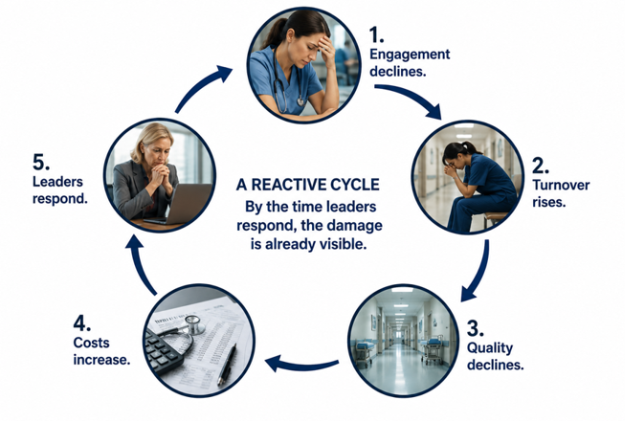
Earlier signals require curiosity. Why are fewer people participating? What is driving overtime? Are concerns being resolved? What has changed in the work environment? As we explored in Why Data in Healthcare Matters, collecting information needs to connect with a plan for responding.
Building an Early Warning System
An early warning system begins with a focused set of measures and a clear response process.
Start With an Outcome That Matters
Choose an organizational priority, such as retaining experienced nurses, improving patient experience, or reducing pressure injuries. Ask: What conditions and practices could influence this outcome before the next report arrives?
Select Meaningful Signals
Identify a manageable set of measures that leaders and teams can influence. Define each measure consistently and establish a baseline. For retention, this might include overtime trends, internal applications, and follow-through on concerns raised during rounding.
Review Trends With the People Doing the Work
Review patterns over time and examine differences across units, roles, or shifts. Organizational averages can conceal local challenges. Pair the numbers with staff perspectives. A dashboard can show declining participation; a conversation can reveal whether the cause is workload, meeting access, or a belief that participation changes little.
Connect Signals With Action
Establish who reviews each measure, when review occurs, and what changes warrant further investigation. If overtime rises, leaders should understand the cause and determine an appropriate response. Monitoring becomes useful when it supports timely decisions and visible follow-through.
Check Whether the Signals Are Useful
Continue tracking the related outcome. Do changes in the selected signals help explain what happens next? Also consider unintended consequences. Reducing overtime, for example, requires attention to whether workload or care delays increase elsewhere. The Institute for Healthcare Improvement similarly recommends combining outcome, process, and balancing measures when evaluating improvement.

Organizational Effectiveness Requires Both
Leading and lagging indicators serve complementary purposes. Lagging indicators help leaders assess whether desired outcomes occurred. Leading indicators help them identify conditions they may be able to influence before those outcomes change. Organizations that focus exclusively on lagging indicators risk becoming highly skilled at explaining yesterday’s problems. Organizations that also monitor meaningful leading indicators create opportunities to influence tomorrow’s results.
The Most Effective Leaders Ask Different Questions
Effective leaders continue asking, “How are we performing?” They also ask:
- What is changing before the outcome changes?
- Where are the staff describing concerns our dashboard does not show?
- Which patterns need attention now?
- What can we influence, and who needs to participate?
- Have we followed through on what people told us?
- How will we know whether our response helped?
Healthcare organizational effectiveness depends on understanding the conditions that create outcomes. Because by the time the data changes, the signals may have been there all along.
Turn Early Signals Into Meaningful Action With CHCM
Understanding leading and lagging indicators in healthcare is most useful when leaders connect what they learn with action. Creative Health Care Management partners with healthcare organizations to strengthen leadership, culture, engagement, and the structures that support organizational effectiveness. Through assessment and collaborative exploration, CHCM helps leaders understand barriers and identify meaningful opportunities for improvement.
What might your organization’s signals be telling you? Connect with CHCM to explore the conditions behind your outcomes and opportunities to respond earlier.
Frequently Asked Questions About Leading and Lagging Indicators in Healthcare
Lagging indicators measure outcomes that have already occurred, such as turnover or readmissions. Leading indicators track conditions or practices that may influence future outcomes, such as overtime trends or completion of prevention practices. Healthcare organizations need both to understand performance and guide action.
Potential examples include staffing instability, overtime utilization, governance participation, leader rounding, follow-through on employee concerns, and adherence to care processes. Their usefulness depends on the outcome being monitored and the organization’s context.
Yes. Vacancy rates describe an existing staffing outcome but may also signal future workload or staffing challenges. A measure’s role depends on its relationship to the outcome leaders want to understand.
Leading indicators can identify patterns that warrant attention, but they do not guarantee an outcome. Leaders should examine trends, seek staff perspectives, and evaluate whether the selected measures provide useful insight in their organization.
Start with a priority outcome, identify conditions that may influence it, and select measures the organization can consistently monitor and act on. Include the people doing the work and revise the measures as the organization learns.
Organizational Effectiveness Requires Both
Leading and lagging indicators are not competing approaches… healthcare organizations need both. Lagging indicators tell leaders whether they achieved the desired outcome and leading indicators help leaders influence the outcome before it occurs. One measures performance and the other helps shape it. Organizations that focus exclusively on lagging indicators risk becoming highly skilled at explaining yesterday’s problems. Whereas organizations that monitor leading indicators create opportunities to influence tomorrow’s results.
The Most Effective Leaders Ask Different Questions
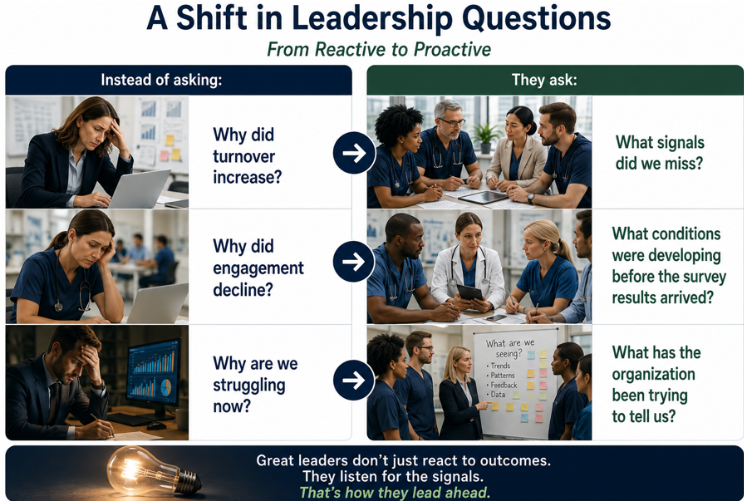
Healthcare organizational effectiveness depends not only on measuring outcomes but on understanding the conditions that create them.
Because by the time the data changes, the signals have often been there all along.

Gen is driven by the desire to help clients create organizational excellence through measurable improvement. She thrives on helping others reach meaningful goals, including Magnet® designation.